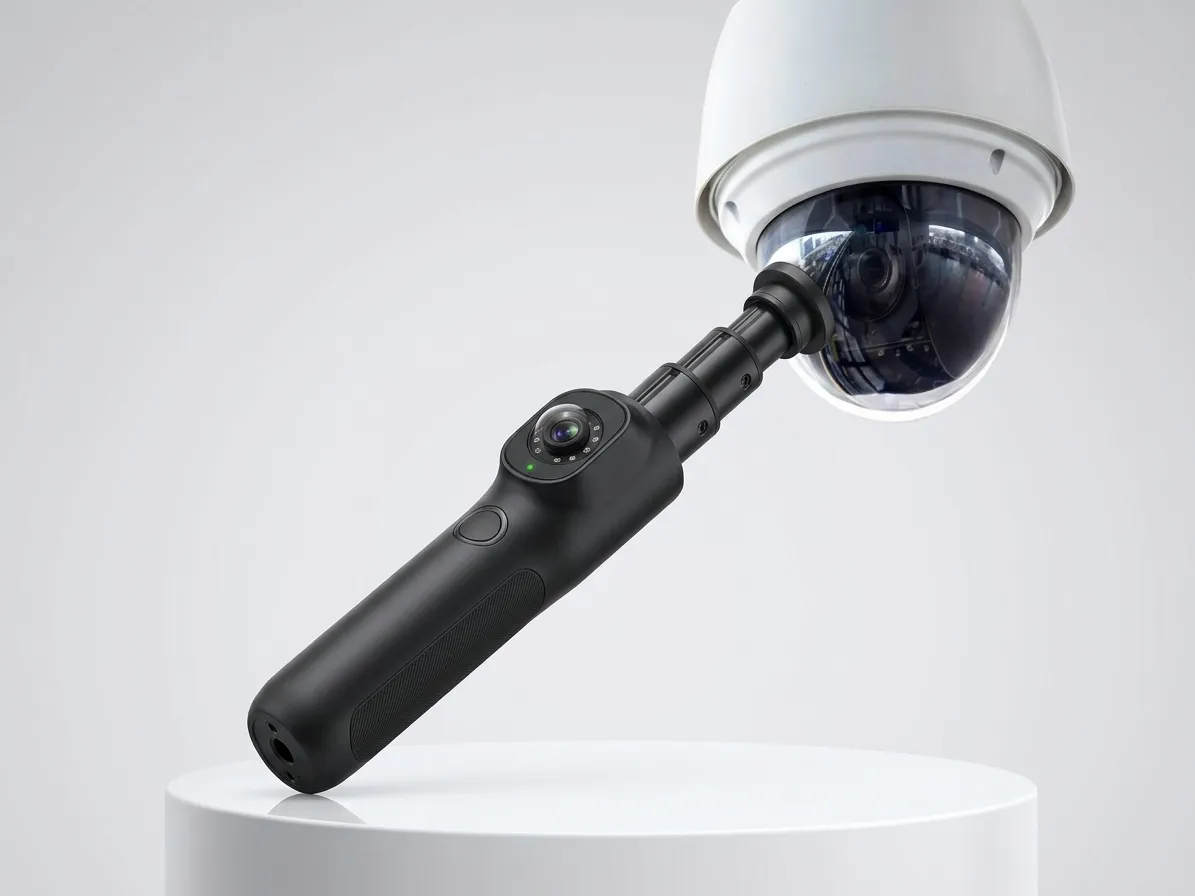
Flock Safety entered the consumer electronics market Wednesday with the launch of the Flock Reach, a telescoping selfie stick the company describes as “the first personal photography accessory built around the entire moment, not just the person in it.”
The Reach looks like an ordinary selfie stick, with an adjustable phone mount and a Bluetooth shutter button in the handle. The difference is a second camera on the back of the grip, which the company calls the Context Lens. It points away from the user and records everything behind them in a 180-degree arc, including faces, vehicles, licence plates and “any other details that might matter later.”
“People have always said a photo captures a memory,” said Derek Halvorsen, Flock’s vice-president of consumer experience, at the launch event. “We asked a simple question. Whose memory? And the answer was: potentially everyone’s.”
Features
Each photo taken with the Reach is automatically uploaded to Flock’s cloud, where the company’s software catalogues the background. Users can then search their own photos by date, location, vehicle colour or “general demeanour.”
The headline feature, called Who Else Was There, lets users see every person and car that appeared behind them on a given trip. By default, it also allows other Reach owners to search the user’s photos in return.
“It’s reciprocal,” Halvorsen said. “You get to remember your vacation, and your vacation gets to be remembered by the community.”
The company stressed that the Reach does not use facial recognition. Instead, it uses what Flock calls face familiarity, which Halvorsen described as “the same thing, but it feels more like a reunion.”
The stick retails for US$89.99, plus a US$12.99 monthly Memories Plan required to view photos older than seven days. A separate neighbourhood tier allows homeowners’ associations to buy Reach units in bulk and combine members’ selfies into a single shared archive, which the company calls a Memory Network.
Better selfie spots
Beta testers say the Reach’s companion app is its most useful feature. Using location data, it suggests “high-value selfie spots” nearby and sends a golden hour notification when lighting conditions are ideal.
Several testers noted that the suggested spots are almost always four-way intersections, gas station forecourts or the exits of big-box store parking lots. Golden hour notifications tend to arrive between 7:30 and 9 a.m. and again between 4:30 and 6 p.m. on weekdays.
“The light wasn’t great, honestly,” said one tester from Phoenix, who was prompted to take 40 photos of herself at a highway on-ramp. “But the app gave me a badge, so I assume something else was.”
Users earn Community Contributor points for each photo. Points can be redeemed for accessories, including a larger battery pack and an extension that raises the stick to three metres, which the company recommends for “crowded or elevated moments” such as bridges.
Early reviews
Early reviews have been largely positive about the hardware. One consumer technology site praised its build quality and image clarity, noting that the Reach “takes a perfectly average photo of you and an extraordinary photo of the man behind you.”
Privacy advocates were more cautious.
“I want to be fair. It’s a very well-made selfie stick,” said Priya Nandakumar of the Digital Liberties Institute. “My concern is mainly that it’s a camera network that people pay to carry around, and it has figured out how to get them to point it at traffic.”
Halvorsen said the company takes those concerns seriously and has added a privacy mode. When it is enabled, the Context Lens stays on, but the user is removed from the photo.
Next steps
Flock says early feedback has already shaped its product roadmap. The most common complaint from testers was that holding the stick up for long periods became tiring, particularly during the recommended golden hours.
In response, the company announced the Reach Pro, available next spring. It features a four-metre stick, a solar panel and a concrete base, and it is designed to be installed permanently at the user’s favourite selfie spot so it can keep capturing memories after they leave.
“A lot of our customers said they wished they could just set it down and walk away,” Halvorsen said. “So we built one that you can.”
The Reach Pro does not include a front-facing camera.